

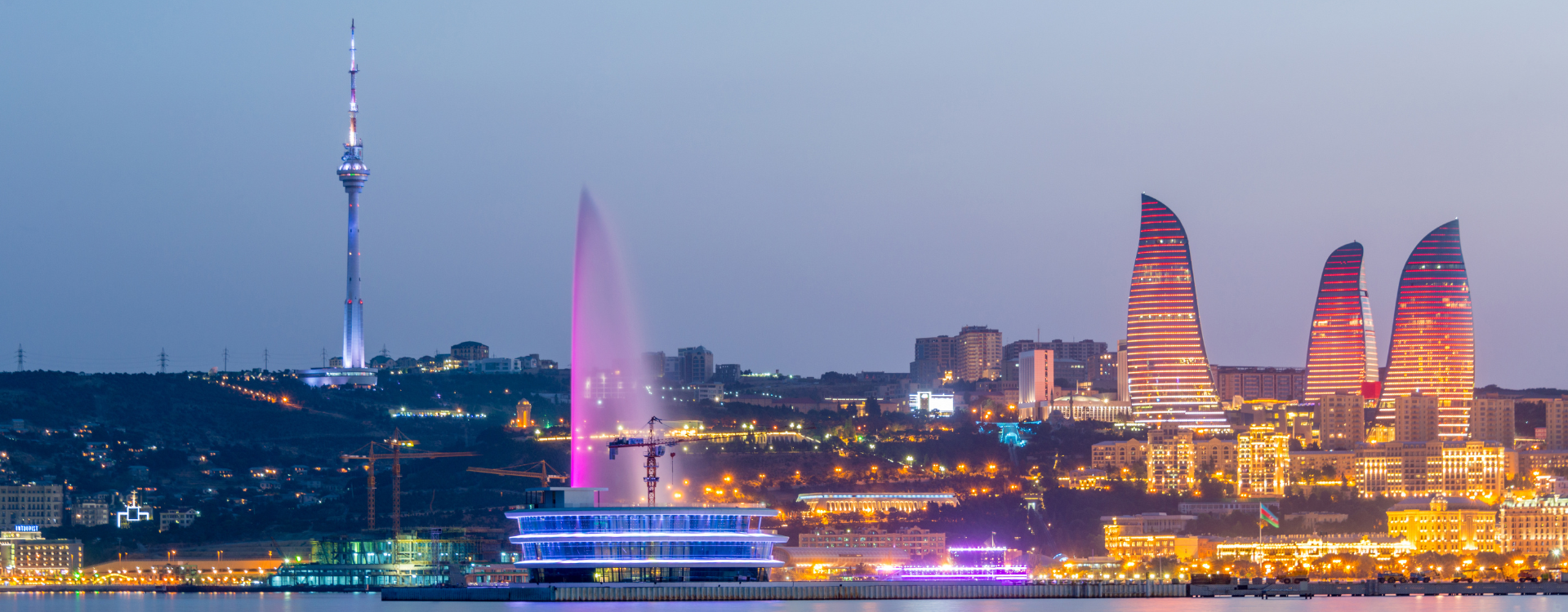
Azerbaijan is a country of striking contrasts and quiet elegance. Where ancient Silk Road heritage meets bold contemporary architecture, where fire has been worshipped for millennia, and where the Caspian Sea borders a capital city that feels both refined and raw. Often called the Land of Fire, Azerbaijan blends East and West with remarkable ease. Travelling here feels like discovering a destination that is still refreshingly under the radar, rich in culture, landscapes, and sincere hospitality. It is a place for curious travellers who value authenticity, depth, and unexpected beauty.
Highlights and Must-See Attractions
Baku
The capital city is a captivating mix of old and new. Wander through the UNESCO-listed Old City with its narrow alleyways, caravanserais, and the Maiden Tower, then contrast it with the futuristic Flame Towers and the flowing curves of the Heydar Aliyev Center. The Caspian Sea boulevard is ideal for an evening walk.
Gobustan National Park
Located just outside Baku, this UNESCO World Heritage Site features ancient rock carvings dating back tens of thousands of years, alongside surreal mud volcanoes that bubble quietly from the earth.
Sheki
Set against the foothills of the Greater Caucasus, Sheki is one of Azerbaijan’s most charming towns. The Sheki Khan’s Palace, with its intricate stained-glass windows assembled without nails, is a true masterpiece.
Absheron Peninsula
This windswept peninsula reveals Azerbaijan’s deep connection to fire and energy through ancient temples, fortresses, and landscapes shaped by natural gas flames.
Caspian Sea Coast
Elegant beaches near Baku and quieter stretches further south provide a gentle contrast to the country’s cultural and historical depth.
Shahdagh Mountain Resort
Located in the Greater Caucasus Mountains, Shahdagh is Azerbaijan’s leading mountain destination. In winter, it becomes a modern ski resort offering downhill skiing, snowboarding, and snowshoeing. In summer, the area transforms into a cool alpine escape ideal for hiking, mountain biking, horseback riding, and fresh-air retreats.
Our Lesser-Known Favourites
Khinalug
One of the highest continuously inhabited villages in Europe, dramatically set in the Caucasus Mountains and home to ancient traditions and spectacular views.
Lahij
A historic mountain village known for its stone streets, copper workshops, and preserved craftsmanship passed down through generations.
Ganja
A lively regional city with leafy parks, literary heritage, and a blend of Soviet and classical architecture.
Naftalan
A unique spa town famous for its therapeutic oil baths, a tradition found nowhere else in the world.
Candy Cane Mountains
Striped hills near Khizi displaying striking red, white, and pink layers, especially beautiful at sunrise and sunset.
Did You Know?
Azerbaijan has one of the world’s highest concentrations of mud volcanoes.
The country’s name is linked to the ancient concept of fire, reflecting its natural gas heritage.
Baku lies below sea level, making it one of the lowest-lying capital cities in the world.
Azerbaijan offers both Caspian Sea beaches and alpine skiing within the same country.
Food and Cuisine
Azerbaijani cuisine is deeply tied to hospitality and seasonality, shaped by Persian, Turkish, Caucasian, and Central Asian influences.
Plov
The national dish made with saffron-infused rice, herbs, dried fruits, and meat. Each region prepares it differently, and it is often the centrepiece of celebrations.
Dolma
Vine leaves or vegetables stuffed with minced meat, rice, and fresh herbs. Simple, comforting, and full of flavour.
Kebab and Grilled Meats
Cooked over open flames and served with flatbread, herbs, and sumac.
Qutab
Thin flatbreads filled with herbs, meat, or pumpkin, cooked on a griddle and served with yoghurt.
Tea Culture
Tea plays a central role in daily life and hospitality. Served in pear-shaped glasses, it accompanies conversation and is often paired with fruit preserves.
Cultural Etiquette and Local Customs
Greetings and Interactions
Handshakes are common and usually accompanied by direct eye contact and a warm smile. Hospitality is taken seriously, and guests are treated with genuine generosity. Respect for elders is an important cultural value.
Dining Etiquette
If invited to someone’s home, expect abundance. It is polite to taste everything offered, even in small portions. Tea is often served at the beginning or end of a meal, and refusing it may seem impolite.
Dress Code Considerations
Dress in Baku is modern and relaxed. In rural areas, mountain villages, and religious sites, modest clothing covering shoulders and knees is appreciated.
Religious and Sacred Space Protocol
Azerbaijan is a secular country with a Muslim cultural background. When visiting mosques or shrines, dress respectfully and follow local guidance. Photography is usually allowed, but asking first is courteous.
Communication Style
Communication is polite and direct, but relationships matter. Conversations often begin with informal exchanges before moving to practical topics.
Do’s and Don’ts
Do accept hospitality and tea when offered
Do show respect to elders
Do dress modestly outside major cities
Do take time for conversation and connection
Do not rush social interactions
Do not refuse food or drink abruptly
Do not photograph people without permission
Do not assume English is spoken everywhere
Essential Azerbaijani Phrases
Basic Greetings
Hello
Salam (sah-LAHM)
Good morning
Sabahınız xeyir (sah-bah-huh-NUHZ hay-EER)
Good evening
Axşamınız xeyir (akh-shah-huh-NUHZ hay-EER)
Goodbye
Sağ olun (sah-OL-oon)
Polite Expressions
Please
Zəhmət olmasa (zah-MET ol-MAH-sah)
Thank you
Təşəkkür edirəm (teh-shek-KOOR eh-dee-REM)
You’re welcome
Buyurun (boo-YOO-run)
Excuse me or sorry
Bağışlayın (bah-ghish-LAI-un)
Useful Questions
How much is this
Bu neçəyədir (boo neh-cheh-YEH-deer)
Where is
Haradadır (hah-rah-dah-DEER)
Do you speak English
Siz ingilis dilində danışırsınız (seez een-ghee-LEES dee-leen-DEH dah-nuh-SHEER-suh-nooz)
Can you help me
Mənə kömək edə bilərsiniz (meh-NEH KOE-mehk eh-deh bee-LER-suh-neez)
Dining and Travel
Delicious
Çox dadlıdır (chok dahd-LUH-deer)
Water, please
Su zəhmət olmasa (soo zah-MET ol-MAH-sah)
The bill, please
Hesabı zəhmət olmasa (heh-sah-BUH zah-MET ol-MAH-sah)
I’m lost
Azmışam (ahz-MUH-shahm)
Practical Information
Best Season to Visit
April to June and September to October offer the most pleasant weather for cultural travel and nature. December to March is ideal for winter sports in Shahdagh, while summer provides cooler temperatures in the mountains than in Baku.
Temperature
Conditions range from cold, snowy winters in the Caucasus to hot summers along the Caspian coast.
Visa Requirements
Most travellers require an electronic visa, which can be obtained online prior to arrival.
Access
Baku’s international airport connects Azerbaijan with major hubs including Dubai, Istanbul, Doha, and several European capitals. Shahdagh is accessible by road from Baku in approximately four hours.
Getting Ready for Departure
Currency: Azerbaijani Manat (AZN)
Language: Azerbaijani is the official language; Russian and English are commonly spoken in cities
Driving: Right-hand side; traffic can be lively in Baku
Electricity: 220V with Type C and Type F plugs
Dress Code: Comfortable city clothing, warm layers for mountain regions, modest attire for rural areas
Final Word
Azerbaijan is a destination that rewards curiosity in every season. From ancient fire temples and vibrant cities to alpine slopes and remote mountain villages, it offers remarkable diversity within a compact journey. Whether you come for culture, cuisine, nature, or winter sports, Azerbaijan leaves a lasting impression that feels both refined and refreshingly authentic.