

How to Justify a Corporate Retreat Budget: A Strategic Guide for 2026
With global disengagement costing the economy nearly nine trillion dollars in lost productivity, can any forward-thinking leader truly afford to view team connection as a discretionary expense? You’ve likely felt the sting of a carefully crafted proposal being dismissed as a mere holiday or heard the suggestion that a simple video call could achieve the same results. It’s difficult to advocate for meaningful connection when the C-suite sees only a line item rather than a catalyst for growth. Understanding how to justify a corporate retreat budget is no longer about picking a beautiful destination; it’s about demonstrating how a purposeful environment directly impacts your bottom line.
We’ll show you how to transform your retreat from a perceived cost into a high-impact strategic investment that wins executive approval. You’ll learn to use data-backed evidence, such as the 26% increase in productivity seen after offsite retreats, to build an unshakeable business case. We’ll explore a clear framework for presenting your vision, ensuring your leadership sees the value in curated, shared experiences that foster genuine alignment. From navigating logistical anxieties to proving long-term ROI, this guide provides the tools to move beyond travel and into the realm of transformative corporate growth.
Key Takeaways
- Reframe the retreat from an operational overhead to a vital investment in human infrastructure and team connection.
- Identify specific metrics of success, including improved talent retention and the measurable impact of cross-departmental knowledge transfer.
- Apply a structured framework for how to justify a corporate retreat budget by aligning every expense with a specific strategic objective.
- Explore design principles that prioritize meaningful engagement and cultural immersion over generic itineraries to maximize your return.
- Transition your planning focus from a simple schedule of events to a results-oriented journey designed to solve unique organizational challenges.
Defining the Strategic Retreat: From Overhead to Investment
A common hurdle when discussing offsites with leadership is the perception that travel is merely a reward or a luxury. When you’re looking at how to justify a corporate retreat budget, the conversation must shift from where the team is going to what the team is solving. In 2026, the hybrid work model has become the global standard, making intentional physical connection a rare and essential resource. The SCN team views every journey through the lens of “Beyond Travel.” This isn’t just a tagline; it’s a business methodology where every element is purposefully designed to address specific organizational friction, whether that’s a lack of departmental synergy or a critical need for leadership alignment.
The Cost of Disconnection vs. The Price of Alignment
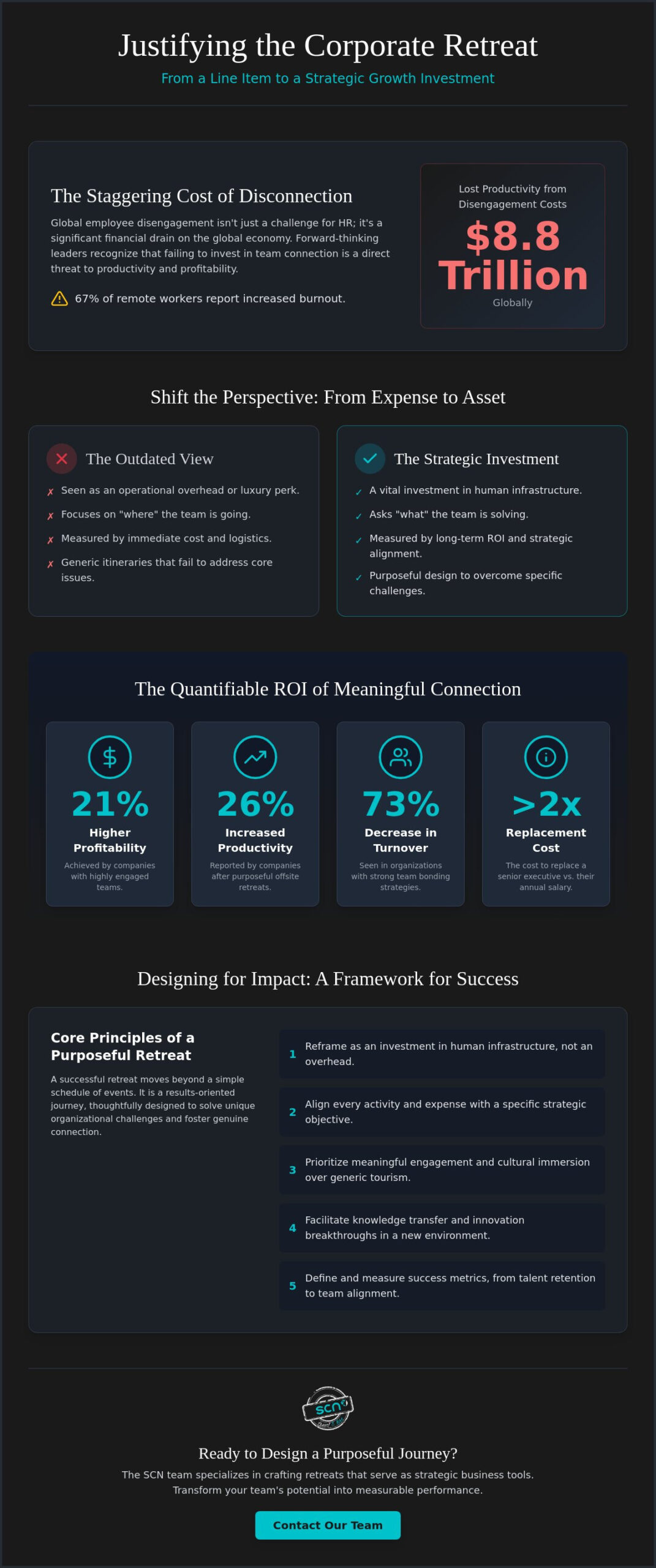
Disconnection isn’t just an HR concern; it’s a financial drain. Low employee engagement costs the global economy trillions in lost productivity, while companies with strong team bonding strategies see a 73% decrease in employee turnover. When you weigh the price of a retreat against the staggering cost of replacing key talent, the investment becomes clear. Shared experiences in a new environment accelerate trust faster than months of digital interactions. Understanding the quantifiable ROI of meaningful team connection allows you to present the retreat as a proactive measure against staff churn and productivity loss.
Moving Beyond Generic Tourism Clichés
Off-the-shelf packages often fail because they treat every team as a monolith. A generic resort stay might offer relaxation, but it rarely facilitates the deep, meaningful breakthroughs required to move a business forward. When you consider how to justify a corporate retreat budget, the focus should remain on tailored itineraries that provide exceptional access to unique environments, from the quiet deserts of the Middle East to the hidden valleys of Europe. These settings are chosen not for their prestige alone, but for their ability to foster shared experiences that resonate long after the team returns home. A purposeful retreat is a strategic business asset designed to transform collective potential into measurable performance.
The Quantifiable ROI of Meaningful Team Connection
When evaluating how to justify a corporate retreat budget, many stakeholders focus on immediate travel costs rather than the long-term impact on the balance sheet. While tax deductibility is a valid consideration, it pales in comparison to the value of Cultural Equity. High-end experiences aren’t just about comfort. They signal the value you place on your leadership. A thoughtfully designed offsite acts as a productivity reset, addressing the 67% of remote workers who report increased burnout by replacing the digital grind with focused, meaningful interaction. Research confirms that highly engaged teams lead to 21% higher profitability, making the case for connection a purely financial one.
Offsites are the most effective way to facilitate Knowledge Transfer ROI. When a CTO and a Head of Sales share a meal in a quiet village in Europe or an exclusive camp in the Middle East, departmental barriers dissolve. These informal shared experiences create the psychological safety required for high-level innovation. If you’re looking to manifest a specific vision for your next gathering, the SCN team specializes in crafting retreats that serve as strategic business tools.
Retention and Recruitment Savings
Replacing a senior executive in 2026 often costs more than double their annual salary when you account for recruitment fees, onboarding, and lost momentum. A well-delivered retreat serves as a powerful non-monetary incentive that reinforces your employer brand. It transforms a standard compensation package into a narrative of shared growth. Curated group journeys act as a retention anchor, building deep interpersonal bonds that make the prospect of leaving the company far less appealing to top talent.
Strategic Clarity and Innovation Breakthroughs
The most valuable business ideas rarely happen in a boardroom. They emerge during “white space” moments in a retreat schedule. By choosing off-the-beaten-path destinations, you pull your team out of their routine and into a state of creative receptivity. Whether it’s a remote retreat in Africa or a boutique experience in Asia, the environment dictates the depth of the thinking. You can find inspiration for these transformative settings by exploring SCN Travel featured destinations, where the focus is always on purposeful travel over generic sightseeing.
Building the Business Case: A Framework for Approval
A successful proposal begins with a clear definition of purpose. It’s about outcomes. Understanding how to justify a corporate retreat budget requires a shift from viewing travel as a perk to seeing it as a necessary tool for cultural maintenance. When you’re presenting your case to a board, you must move beyond a simple list of activities and focus on the specific business problem the journey will solve. Decision-makers don’t buy flights and hotels; they buy the results of a team that returns more aligned, energized, and loyal. Start by identifying your primary objective. Is this a Reward for exceptional performance, a Strategy offsite to pivot your 2026 goals, or a Relationship Building exercise to integrate new leadership? Structure your entire pitch deck around these desired outcomes rather than the chronological itinerary.
Your framework should include a concrete checklist of data points that resonate with a CFO’s perspective. Contrast the investment with the 21% higher profitability seen in highly engaged teams, or the 73% decrease in turnover for companies with strong bonding strategies. When discussing benefits, frame them as value-add advantages such as resort vouchers or exclusive lounge access. These aren’t trivialities; they are thoughtfully designed elements that enhance the sense of appreciation and exclusivity for your high-performing staff.
Mapping Outcomes to Business Goals
The location should never be accidental. If your company’s mission involves sustainability or innovation, choosing a pristine, off-the-beaten-path destination in Europe or Asia reinforces that message visually and experientially. Opting for a boutique agency over a mass-market operator demonstrates a commitment to a tailored, high-quality experience that reflects your own corporate standards. Seamlessly delivered logistics ensure that leadership can focus entirely on strategic alignment rather than being drained by the friction of travel failures, effectively preventing executive burnout before it begins.
The Transparency Factor: Budgeting Without Surprises
Trust is built on transparency. Your budget must be comprehensive, including a contingency fund of at least 10% to accommodate “exceptional access” opportunities or last-minute adjustments that often arise during the discovery phase. The SCN team manages every detail from end-to-end, acting as a worldly facilitator that protects your company’s most valuable asset: time. For those looking to stay closer to home, exploring Corporate teambuilding retreats in the Middle East offers a wealth of purposeful options that align with regional business growth. Ready to transform your proposal into a strategic reality? Connect with the SCN team to begin your strategic design.
Designing for Impact: Maximising the Investment
Approval often hinges on finding the “Middle Way.” This isn’t a compromise on quality, but a commitment to thoughtful design over mindless extravagance. When you consider how to justify a corporate retreat budget, leadership needs to see that the investment is precisely calibrated to achieve your stated goals. At the SCN team, we act as detail-oriented visionaries, ensuring that every element, from the choice of a boutique estate in Europe to the selection of a local guide in Asia, serves a specific strategic purpose. High-end travel doesn’t have to be loud; it should be meaningful.
Measuring the impact of your journey is the final, crucial step in validating the spend. Success isn’t just about the absence of logistical failures. It’s found in the post-retreat data: the shift in cultural sentiment, the achievement of new KPIs, and the qualitative feedback from internal surveys. When a team returns with a shared narrative and a renewed sense of trust, the return on investment becomes self-evident. We focus on creating these lasting interpersonal bonds, moving away from the disconnected nature of mass-market tourism to provide something truly transformative.
Beyond Sightseeing: Curating Shared Experiences
Modern teams crave substance. They want to feel connected to the pristine nature and the essential character of the locations they visit. Meaningful activities, such as engaging in impact travel where teams contribute to local community projects, often leave a deeper impression than traditional sightseeing. These shared experiences foster a sense of collective pride that translates directly into workplace loyalty. For those seeking bespoke event coordination that prioritizes depth over surface-level aesthetics, our SCN MICE services provide the expertise needed to manifest complex visions with calm authority.
The Post-Retreat Momentum
The true value of a retreat is realized in the weeks and months following the return flight. To maintain momentum, it’s vital to integrate the takeaways into your daily office culture, whether that’s through new collaborative workflows or a continued focus on the trust built during the journey. Reporting back to leadership on both “soft” wins, like improved team morale, and “hard” wins, such as the acceleration of a specific project, closes the loop on the business case. It proves that the journey was an investment in your company’s future. If you’re ready to move beyond simple logistics and craft a journey that truly rewards your team, contact the SCN team to design your next purposeful retreat.
Advancing Your Team’s Potential Through Purposeful Design
Securing approval for a meaningful journey requires more than just a list of destinations; it demands a shift in perspective. By focusing on the quantifiable impact on productivity and the long-term savings in talent retention, you move the conversation from cost to value. Understanding how to justify a corporate retreat budget is ultimately about demonstrating how a curated environment acts as a catalyst for alignment and innovation. When the C-suite sees a strategic framework built on desired outcomes rather than just a schedule of events, the retreat transforms into a non-negotiable asset for 2026.
As a boutique agency based in Dubai, the SCN team specializes in high-impact executive retreats that prioritize depth and sincerity. Our global network of local experts ensures exceptional access to off-the-beaten-path locations that inspire creative thinking and strengthen interpersonal bonds. We invite you to partner with the SCN team to design your purposeful corporate retreat and manifest a vision that resonates long after the team returns home. Your team’s future is built on the connections they make today.
Frequently Asked Questions
Is a corporate retreat budget tax-deductible in 2026?
Tax deductibility for corporate retreats depends on the primary purpose of the travel and the specific regulations within your company’s jurisdiction. In many regions, expenses are deductible if the journey is primarily for business training, strategic planning, or professional development. It’s essential to consult with your financial advisor to ensure your documentation clearly links the retreat to these specific business outcomes rather than purely leisure activities.
How much should a company spend per person on an executive retreat?
Spending on executive retreats varies significantly based on the level of customization and the exclusivity of the access required for your leadership team. While industry averages provide a baseline for standard offsites, executive journeys typically prioritize privacy and bespoke design to facilitate high-level strategy. The SCN team focuses on a thoughtfully designed approach where the budget is allocated toward meaningful connection and purposeful environments rather than superficial extravagance.
What is the best way to present a retreat budget to a CFO?
The most effective way to present a retreat budget to a CFO is by framing human capital as a strategic investment rather than a discretionary cost. Lead with a framework that links the travel directly to business goals like talent retention or innovation breakthroughs. Providing data on the cost of employee turnover versus the investment in alignment creates a compelling financial narrative that shifts the focus toward long-term value.
Can we justify a high-quality retreat if the company is in a cost-cutting phase?
Justifying a high-quality retreat during a cost-cutting phase is possible by reframing the journey as a proactive measure against burnout and disengagement. When internal resources are stretched, the need for a productivity reset and collective alignment becomes even more critical. By demonstrating how to justify a corporate retreat budget through the lens of protecting your most valuable assets, you position the experience as a tool for recovery and future growth.
What are the most common hidden costs in corporate retreat planning?
Common hidden costs often include resort fees, audio-visual equipment rentals, and service gratuities that aren’t always visible in an initial venue quote. Logistical burdens such as high-speed Wi-Fi upgrades for remote locations or specialized transportation for off-the-beaten-path experiences can also impact the final tally. The SCN team mitigates these surprises through end-to-end management, ensuring that every logistical detail is accounted for in the initial discovery and planning phase.
How do we measure the ROI of a team-building retreat?
Measuring the ROI of a team-building retreat involves tracking both qualitative cultural shifts and quantitative business metrics over the following six to twelve months. Look for improvements in internal engagement scores, a decrease in staff turnover rates, and the successful completion of strategic goals set during the offsite. These indicators provide clear evidence of how a thoughtfully designed journey translates into measurable organizational performance and lasting interpersonal bonds.