


What to Look for in a Sustainable Hotel: A Guide for Conscious Travelers in 2026
What if the traditional markers of high-end travel are no longer enough to define a truly exceptional stay? For the discerning traveler, the priority is no longer just the thread count of the linens or the exclusivity of the location. Instead, the focus has shifted toward understanding exactly what to look for in a sustainable hotel to ensure every journey contributes to the restoration of the environment and the local culture. You likely feel the weight of skepticism when faced with vague carbon offsetting claims or a confusing array of green labels. It’s understandable to worry that a commitment to the planet might mean a compromise on the quality and personal care you expect from a thoughtfully designed retreat.
The SCN team believes that true purpose and high standards should always go hand in hand. As we move through 2026, new European Union reporting regulations and updated Green Key criteria are finally replacing generic eco-friendly marketing with verifiable, data-backed transparency. This guide offers a clear framework to help you identify authentic environmental stewardship and deep community integration. You’ll discover how to look beyond the surface to find properties that prioritize decarbonization and ethical employment. By the end of this article, you’ll have the confidence to choose stays that foster meaningful connections and ensure your presence supports the essential character of your destination.
Key Takeaways
- Distinguish between superficial greenwashing and authentic commitment by looking for hotels that embed environmental and cultural health into their core business model.
- Master what to look for in a sustainable hotel by prioritizing active on-site decarbonization and renewable energy over passive carbon offsetting programs.
- Evaluate how a property supports its destination through ethical local employment and the thoughtful integration of regional artisans into the guest experience.
- Learn how the SCN team applies rigorous vetting standards to curate tailored itineraries that ensure your stay has a measurable, positive impact on the local community.
Distinguishing Authentic Commitment from Superficial Greenwashing
A stay that truly honors the planet goes far beyond the absence of single-use plastics or the presence of a few solar panels. In 2026, a truly sustainable hotel is defined by how deeply it integrates environmental, social, and cultural health into its fundamental business model. It’s a holistic approach where every operation, from supply chains to employee welfare, is designed to be restorative. For the conscious traveler, identifying these properties requires a discerning eye. You’re no longer looking for generic labels; you’re seeking evidence of a purposeful commitment that aligns with your own values.
Understanding what to look for in a sustainable hotel requires recognizing the shadow of greenwashing. This is a practice where clever marketing is used to mask a lack of substantive action. As we move through this year, travelers are increasingly demanding transparency and evidence-based claims. They want to see the data behind the promises. A purposeful stay is one where high-end comfort and ethical responsibility coexist seamlessly, ensuring that your presence supports the destination rather than depleting it.
The Evolution of Conscious Hospitality
The travel industry has shifted from basic recycling programs to more ambitious regenerative models. These initiatives aim to leave a location better than it was found. Many luxury properties are now leading this movement by funding large-scale conservation projects or restoration efforts. They often follow established eco-hotel criteria to ensure their impact is measurable. This level of transparency is essential for building trust. The SCN team often looks for these deeper commitments when selecting featured destinations for our clients, ensuring every journey remains meaningful.
Red Flags of Greenwashing to Watch For
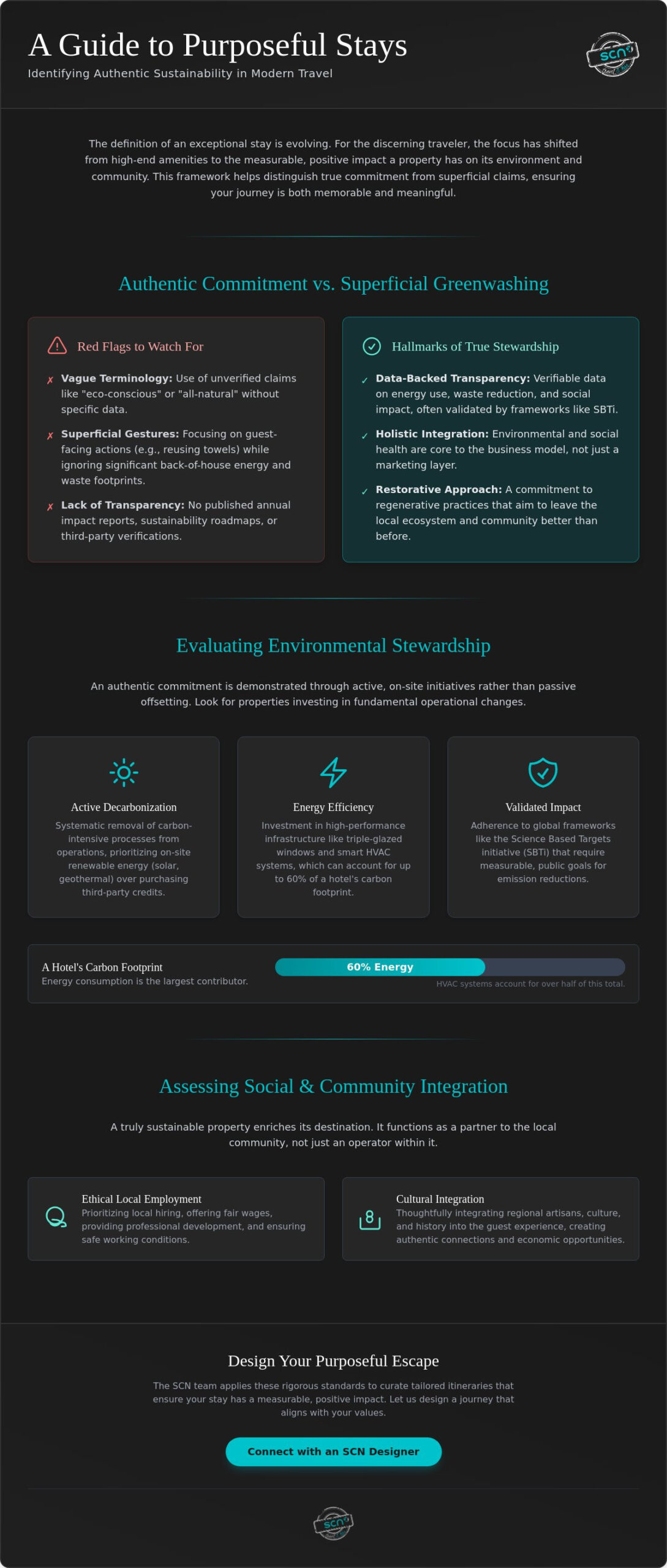
Skepticism is a useful tool when evaluating claims. Watch for vague terminology like “all-natural” or “eco-conscious” that lacks specific data or third-party verification. Often, hotels focus on guest-facing gestures while ignoring their back-of-house energy and waste footprints. If a property doesn’t publish an annual impact report or a clear sustainability roadmap, it’s a sign that their commitment might be superficial. Authentic partners are always proud to share their progress and their challenges. They don’t hide behind buzzwords; they lead with accountability.
Evaluating Environmental Stewardship and Decarbonization Efforts
The distinction between a hotel that simply pays for its impact and one that actively reduces it is a critical factor for the conscious traveler. While carbon offsetting has long been a standard practice, it often functions as a secondary measure rather than a primary solution. For those determining what to look for in a sustainable hotel, the focus must shift toward decarbonization. Decarbonization is the systematic removal of carbon-intensive processes from a property’s operations. This involves a fundamental redesign of how a hotel functions, ensuring that luxury is delivered through efficiency rather than excess.
Technical transparency is the hallmark of a truly committed property. High-end hotels leading this change often invest in high-performance building envelopes, including triple-glazing and smart HVAC systems that respond to real-time occupancy. According to verified data, energy consumption accounts for approximately 60% of a hotel’s carbon footprint, with HVAC systems alone responsible for 50-60% of that total. Properties that prioritize these infrastructure upgrades demonstrate a long-term commitment that goes beyond marketing. You can find more details on these performance benchmarks in the EPA’s guide to green hotel standards, which provides a rigorous baseline for environmental excellence.
Measuring Real Impact Beyond Offsets
Authentic stewardship is often validated by global frameworks like the Science Based Targets initiative (SBTi). These standards require hotels to set specific, measurable goals for reducing their own emissions rather than relying on third-party credits. When evaluating a stay, look for on-site renewable energy sources such as geothermal heating or expansive solar arrays. In water-stressed regions like the Middle East or parts of Africa, advanced water stewardship through greywater recycling and desalination is equally vital. These systems ensure that a guest’s comfort doesn’t come at the expense of the local community’s essential resources.
Waste Management and the Circular Guest Experience
A circular economy within a hotel means that every resource is thoughtfully managed to eliminate the concept of waste. This includes zero-waste kitchens that utilize composting and maintain direct partnerships with local farms to source seasonal ingredients. In the rooms, biodegradable amenities and the total elimination of single-use items across the supply chain are now baseline expectations for luxury hospitality. Some visionary designers even incorporate recycled materials into the hotel’s architecture, turning discarded resources into bespoke interior elements. The SCN team applies this same level of scrutiny when designing meaningful group journeys and retreats, ensuring every partner meets our high standards for environmental integrity.
Assessing Social Impact and Local Community Integration
While technical efficiency is vital, the true pulse of a destination lies in its people. When considering what to look for in a sustainable hotel, the human element is often the most profound differentiator. A property can have the most advanced solar array in the world, yet if it remains a disconnected island within its community, it isn’t truly sustainable. Authentic hospitality recognizes that the well-being of the residents is inextricably linked to the quality of the guest experience. This means looking beyond the physical structure to see how a hotel breathes life into its surroundings through meaningful integration.
Empowering Local Communities
One of the clearest indicators of a hotel’s social commitment is its approach to employment. You should look for properties where local residents occupy leadership and management roles, rather than being restricted to entry-level service positions. This demonstrates a genuine investment in local talent and long-term career development. Sourcing is another vital pillar; a hotel that fills its halls with regional art and its kitchens with produce from nearby farmers creates a powerful economic multiplier. It protects the essential character of the location, ensuring that the destination’s unique identity remains vibrant for generations to come.
Meaningful Cultural Connections
The SCN team believes that every journey should foster shared experiences and interpersonal bonds. When evaluating a potential stay, seek out properties that offer thoughtfully designed cultural immersion programs. These shouldn’t be choreographed ‘tourist traps’ but rather authentic exchanges that respect the dignity of the hosts. Whether it’s a private workshop with a master weaver or a guided walk through a lesser-known neighborhood, these moments should feel like a bridge between cultures. Explore our featured destinations for examples of community-centric journeys that prioritize these deep connections.
Philanthropy also plays a role in this social fabric. Many leading sustainable hotels establish dedicated arms to fund local education, healthcare, or conservation initiatives. This ensures that a portion of every guest’s stay directly supports the region’s most pressing needs. If you’re ready to plan a journey that balances high-end comfort with deep social responsibility, the SCN team is here to design curated group journeys and retreats that align with your personal values and the destination’s future.
Designing Your Purposeful Escape with Expert Curation
Identifying what to look for in a sustainable hotel is an essential skill for the modern, conscious traveler who wishes to see the world without harming it. Yet, the reality of verifying technical decarbonization data or auditing a hotel’s social impact can become an overwhelming logistical burden. This is where the role of a boutique travel designer evolves from a simple coordinator to a worldly facilitator. The SCN team takes on the thorough process of discovery, ensuring every partner we recommend is not just green in name, but regenerative in practice. We manifest your complex, ethical visions by handling the intricate details, allowing you to enjoy a stay that is both high-end and deeply meaningful without the stress of constant verification.
The SCN Approach to Partner Selection
Our approach to partner selection is rooted in passion and sincerity. We look beyond the standard certifications to witness the actual on-the-ground impact a property has on its environment and its people. We prioritize properties that offer exceptional access to unique, curated experiences, ensuring your stay is defined by wonder rather than a transactional relationship. This level of scrutiny is a core pillar of how we operate, reflecting the high standards set by Stephanie Neuer. For a closer look at how we design these journeys, Sustainable Luxury Travel Itineraries provide a blueprint for your next journey.
Tailoring Your Journey for Maximum Impact
A tailored itinerary is more than just a schedule; it’s a way to ensure your journey aligns with the specific needs of the destination. When we design corporate retreats or private group journeys, we focus on shared experiences that foster interpersonal bonds and deeper learning. Every aspect of the trip is seamlessly delivered, from arranging low-impact transport to sourcing ethical dining that celebrates local artisans. Bespoke planning ensures your travel investment directly benefits the environments and cultures you visit. This thoughtfully designed approach removes the stress of planning, leaving you free to connect with the essential character of the location. By prioritizing these meaningful connections, we help you create a legacy of positive impact that lasts long after you return home.
Embracing a Future of Purposeful Exploration
The path toward conscious travel represents a shift from being a mere observer to becoming an active participant in the restoration of our world. By understanding exactly what to look for in a sustainable hotel, you gain the clarity to choose partners who prioritize measurable decarbonization over vague promises and who weave local communities into the very fabric of their success. It’s about finding those rare spaces where high standards and ethical integrity coexist without compromise. True value in 2026 is found in these authentic connections and the security that comes from knowing your presence leaves a positive, lasting legacy.
The SCN team draws upon deep expertise in the Middle Eastern and European luxury markets to navigate these complexities for you. Through our global network of vetted local experts, we specialize in bespoke, outcome-driven travel design that ensures every detail is aligned with your values. We invite you to step away from the logistical burden of verification and trust in a process that prioritizes meaningful impact and exceptional access. Contact the SCN team to design your next purposeful journey and discover how a curated approach can transform your experience of the world. Your next adventure awaits, and it’s ready to be as impactful as it is memorable.
Frequently Asked Questions
What are the most reputable sustainability certifications for hotels in 2026?
Reputable labels such as Green Key, EarthCheck, and those accredited by the Global Sustainable Tourism Council (GSTC) remain the industry gold standard. New Green Key criteria take effect on October 1, 2026, requiring even more rigorous evidence of environmental stewardship from all applicants. These certifications are vital because they require independent, third-party audits rather than allowing a property to simply self-report its achievements. This ensures the high standards you expect are consistently met and verified.
How can I verify if a hotel’s carbon neutral claims are legitimate?
Legitimate claims are always backed by verifiable data rather than vague promises of future offsetting. In 2026, look for properties following the European Union’s new sustainability reporting standards under the Corporate Sustainability Reporting Directive. These regulations require hotels to report their environmental impact using standardized measurements for energy and water consumption per guest night. A hotel truly committed to decarbonization will openly publish these metrics in an annual impact report that is accessible to the public.
Does a sustainable hotel mean I have to sacrifice luxury or comfort?
Choosing a conscious stay never requires a compromise on quality or personal care. Many of the most thoughtfully designed properties use sustainability to actually enhance the guest experience, such as utilizing high-performance building envelopes for superior climate control and soundproofing. Sourcing bespoke, organic linens and handcrafted local furniture creates a more intimate and meaningful connection to the destination. This approach ensures that high-end amenities and ethical responsibility coexist seamlessly throughout your stay.
What questions should I ask the hotel manager about their community impact?
When determining what to look for in a sustainable hotel, ask the leadership about their ratio of local residents in management and leadership positions. Inquire specifically about their procurement policies for food, art, and textiles to see if they prioritize regional artisans. You should also ask for details on specific community projects they fund, such as local education or healthcare initiatives. Authentic partners will describe these interpersonal bonds with sincerity and provide concrete examples of their ongoing support.
Is it better to stay in a large eco-certified resort or a small locally-owned boutique hotel?
Both options offer distinct advantages depending on the specific outcomes of your journey. Large resorts often have the capital to implement massive infrastructure changes, such as on-site solar arrays or complex greywater recycling systems. Conversely, small boutique hotels typically provide deeper cultural immersion and more direct economic support to the immediate neighborhood. The SCN team often recommends a tailored approach that evaluates each property based on its measurable impact and its ability to deliver a curated, personal experience.
How does sustainable travel benefit the local communities in the Middle East and Africa?
Sustainable travel in these regions focuses on protecting essential resources and fostering economic empowerment. By prioritizing advanced water stewardship in water-stressed areas, hotels ensure that guest comfort doesn’t deplete the local supply. Sourcing from regional producers keeps capital within the community and protects the essential character of the location. This creates a cycle of respect and prosperity, ensuring that your presence supports the long-term health and vibrancy of the destinations you visit.